The Sony IMX989 is a notable image sensor primarily designed for flagship smartphones, marking a significant step towards using larger-format sensors in mobile photography.
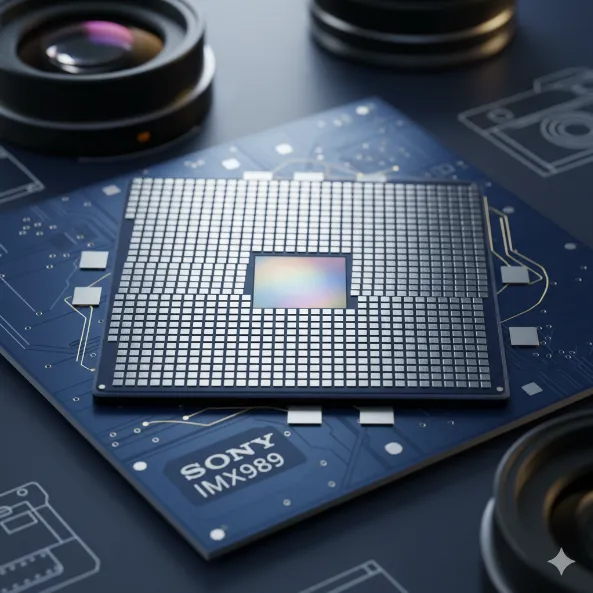
The Sony IMX989 is a high-performance CMOS image sensor that brought a large physical size to the premium smartphone market. It was co-developed by Sony and Xiaomi, with the latter being the first to feature it in a mass-produced device (the Xiaomi 12S Ultra). Its key characteristic is its large dimensions, which significantly improve light-gathering capability and overall image quality compared to typical smartphone sensors.
There isn’t a single “best” camera sensor, as the optimal choice depends heavily on the application (smartphone, mirrorless camera, professional cinema camera), shooting conditions, and features prioritized (low-light performance, resolution, dynamic range, video capabilities).
Table of Contents
However, the general rule is: A larger sensor is better.
Key Factors That Determine Sensor Performance Of Sony IMX989
| Factor | What it Means | Why it Matters |
| Sensor Size (Optical Format) | The physical dimensions of the sensor (e.g., $1/1.3$ inches, $1$ inch, Micro Four Thirds, Full-Frame). | A larger sensor has a greater total surface area to capture light, leading to better low-light performance, less noise, and greater potential for a shallow depth of field (blurrier background). |
| Pixel Size ($\mu$m) | The size of the individual photodetectors (pixels) on the sensor (e.g., $0.5\mu\text{m}$ vs. $1.6\mu\text{m}$). | Larger pixels (especially when a lower-resolution image is created via pixel binning like $4$-in-$1$ or $16$-in-$1$) can collect more light, significantly improving low-light sensitivity and reducing noise. |
| Resolution (Megapixels) | The total number of pixels on the sensor (e.g., $12\text{MP}$ vs. $200\text{MP}$). | Higher resolution captures more detail, which is great for large prints or heavy cropping, but very high MP counts often use very small pixels, which can compromise low-light performance unless advanced pixel-binning is used. |
| Technology | Stacked CMOS (faster readout, better video), Back-Illuminated (BSI) (better light collection), and proprietary features (like Sony’s Exmor or Samsung’s ISOCELL technologies). | These innovations reduce noise, increase processing speed, and improve dynamic range. |
Key Specifications and Features Of Sony IMX989
| Feature | Specification/Detail |
| Sensor Type | CMOS, Back-Illuminated (BI) |
| Optical Format (Size) | 1-inch Type (approx. $13.2 \text{mm} \times 8.8 \text{mm}$ or $16 \text{mm}$ diagonal) |
| Native Resolution | 50.3 Megapixels (MP) |
| Native Pixel Size | Approx. $1.6 \mu\text{m}$ (micrometers) |
| Pixel Binning | Supports 4-in-1 pixel binning |
| Binned Pixel Size | Effectively $3.2 \mu\text{m}$ (resulting in a $\approx 12.5 \text{MP}$ image) |
| Primary Benefit | Superior low-light performance, wider dynamic range, and more natural depth of field (bokeh). |
| Color Filter Array | Quad-Bayer (or similar) |
Key Technological Highlights
1. The “1-Inch Type” Format
The Sony IMX989 utilizes a 1-inch type sensor, which, in the context of digital imaging, refers to an imaging area with a diagonal of approximately $16 \text{mm}$. While this is not a literal 1-inch diagonal measurement, this large format is a major breakthrough for smartphones. A physically larger sensor collects significantly more light than smaller, more common smartphone sensors, leading to:
- Reduced Noise: Cleaner images, especially in low-light environments.
- Wider Dynamic Range: Better detail preserved in both bright highlights and deep shadows.
- Shallow Depth of Field: A more natural, optical background blur (bokeh) for portraits, which previously required heavy computational photography to simulate.
2. Quad-Bayer and Pixel Binning
The sensor features a high native resolution of $50.3 \text{MP}$ but is often used in a pixel binning mode. This process combines data from four adjacent pixels into one, resulting in a $12.5 \text{MP}$ output image with a much larger effective pixel size of $\approx 3.2 \mu\text{m}$. This large effective pixel size is the primary factor enabling its excellent performance in dark conditions.
3. Optimized for Mobile
Unlike earlier 1-inch sensors used in mobile phones (like the one in the Sony Xperia Pro-I, which was a cropped version of a digital camera sensor), the Sony IMX989 was reportedly designed specifically for smartphones. This means its architecture, readout speed, and power consumption are optimized for the constraints of a mobile device.
- Firozabad का AQI-167: हवा में घुला ‘जहर’! 6 december 2025
- Aaj Ka Rashifal: Daily Rashifal, 6 december 2025
- OPPO A6x 5G: Just ₹12,499 | 6500mAh + 45w Fast Charging| Is It Worth?
- Aaj Ka Rashifal: Daily Rashifal, 5 december 2025
- Dhamakedaar Launch! realme P4x 5G इंडिया में आया, Price है ‘Budget King’!
Applications
The Sony IMX989 is typically reserved for ultra-premium flagship smartphones due to its size, cost, and complexity of integrating the necessary large-aperture optics. Prominent phones that have featured this sensor include models from:
- Xiaomi (e.g., Xiaomi 12S Ultra, 13 Pro)
- Vivo (e.g., Vivo X90 Pro)
- OPPO (e.g., OPPO Find X6 Pro)
The Sony IMX989 represents a key milestone in the trend of equipping smartphones with camera hardware that delivers a performance closer to dedicated digital cameras.
- Best Website Speed Test
- JPG to PNG to WEBP converter
- Convert Any File Into PDF
- Facts About Tomatoes That You May Not Know
- Age Calculator
- Vicky Kaushal & Katrina Kaif Announce Pregnancy: A New Chapter Begins
Aaj Ka Rashifal agra amazing fact Aquarius Aries Astrology Cancer Capricorn Daily Rashifal environmental issue Exams fact firozabad Firozabad pollution Firozabad का AQI Gemini GK Notes for Exams health warning hindi horoscope important questions Indian railway industrial chimney kanpur Leo Libra Moderate air quality Pisces PM2.5 Poor AQI Rashifal Sagittarius Scorpio South Asia smog Taurus Unhealthy UP air pollution Uttar Pradesh Virgo अस्वस्थ ज्योतिष तथ्य फ़िरोज़ाबाद वायु प्रदूषण स्थिति और स्वास्थ्य
1 thought on “Sony IMX989; Best Camera Sony Sensor”