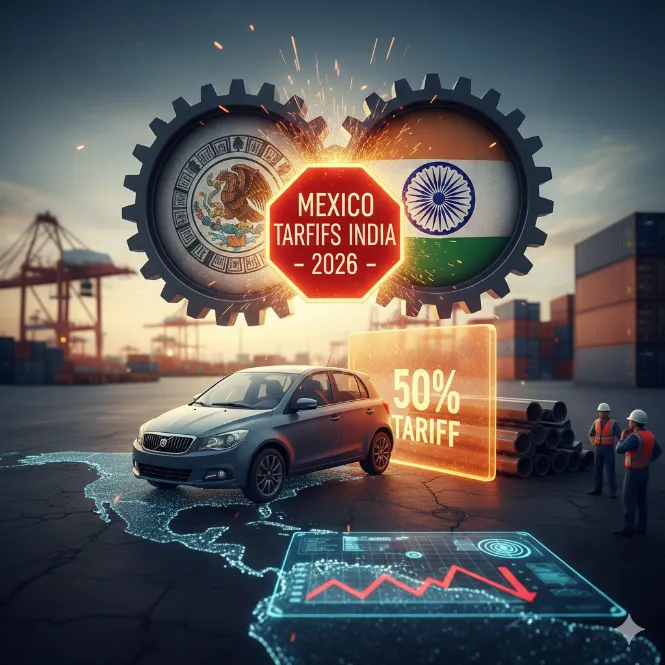
Mexico’s government has approved a new, significant tariff regime that will affect a wide range of imports from countries without a Free Trade Agreement (FTA), including India, China, South Korea, Thailand, and Indonesia.
This move, passed by the Mexican Senate, marks a decisive shift in its trade policy and is set to take effect starting January 1, 2026.
Table of Contents
The Key Details of the New Tariffs
| Feature | Details | Impact on India |
| Target Countries | Non-FTA partners, prominently including India and China. | India does not have an FTA with Mexico, putting all its non-exempt exports at risk. |
| Tariff Range | Duties will range from 5% to a high of 50%. | Around 75% of India’s annual exports to Mexico (valued at approximately $5.75 billion) are expected to be affected. |
| Implementation Date | Phased implementation beginning January 1, 2026. | Indian exporters have a limited window to adjust supply chains and pricing. |
| Stated Goal | To protect domestic industries (especially textiles, steel, and auto) from perceived unfair competition and to generate additional revenue. | Seen by analysts as aligning with US pressure to curb Chinese-origin goods entering the North American supply chain. |
Sectors Hit Hardest in India
The new duties will be especially punitive on sectors that currently dominate India’s exports to Mexico:
- Automobiles & Auto Components: This is India’s largest export to Mexico.
- Passenger Vehicles: Duties on cars are set to rise sharply, potentially from 20% to 35% (and up to 50% for some light vehicles).
- Auto Components: Duties will jump from 10-15% to 35%, severely disrupting Indian supply chains that feed into Mexico-based manufacturing for the North American market.
- Electronics:
- Smartphones: Currently duty-free, smartphones will face a 35% tariff, which experts warn will effectively shut the Mexican market to Indian handset exports.
- Metals (Steel & Aluminium):
- Steel (Flat Products): Expected to face the highest tariffs, potentially 50%, making Indian steel exports largely non-competitive.
- Textiles, Apparel, and Footwear: Duties are set to increase from 20-25% to 35%, eroding the price competitiveness of Indian garments and leather goods.
- Industrial Machinery: Duties will rise to between 25% and 35%.
Note: The pharmaceutical sector is expected to be largely unaffected, with duties only rising modestly from 0-5% to 0-10%.
Indian and Global Reaction
- Indian Industry: The Society of Indian Automobile Manufacturers (SIAM) has urged India’s Commerce Ministry to intervene and negotiate a solution, stressing that Indian-made compact vehicles do not compete with Mexico’s high-end North American market production.
- Analysts’ View: Many global trade analysts view Mexico’s move as an attempt to appease the United States ahead of the next review of the US-Mexico-Canada Agreement (USMCA). The goal is to prevent Chinese goods from being re-routed through Mexico, inadvertently catching Indian exports in the crossfire.
- India’s Leverage: Since India’s imports from Mexico are significantly lower than its exports (creating a large trade surplus for India), New Delhi is seen as having limited leverage for retaliation and is likely to focus instead on accelerating trade agreement talks and export diversification.Age Calculator